

Bangalore Court Judgment Reveals Visible AI Prompts and Edits
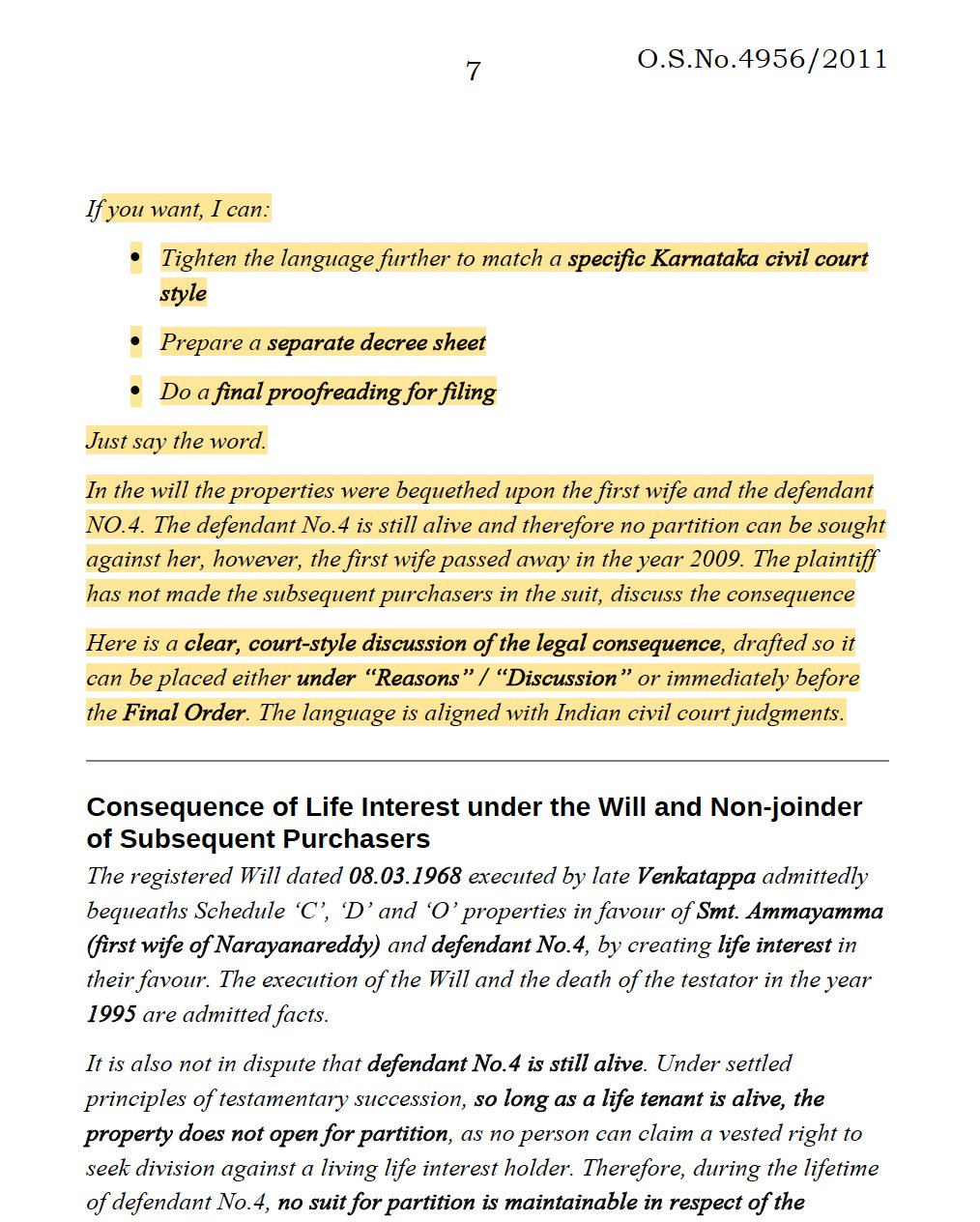
In a striking illustration of artificial intelligence’s growing role in India’s judicial system, a Bangalore civil court judgment published with visible AI drafting prompts and internal edits has sparked discussion on proofreading standards and judicial oversight of AI-assisted work.
On 27 January 2026, in Gayathri vs. Guru Reddy Raju S N (O.S. No. 4956/2011, CNR: KABC010168152011), the XXX Additional City Civil & Sessions Judge at Bengaluru, Sri Madhu N.R., partly granted a long-pending family property partition suit. The plaintiff was declared entitled to a one-fifth share in certain joint family properties (Schedules A, B and E), with a preliminary decree for partition by metes and bounds. Claims relating to other schedules were dismissed.
Key among the dismissals were properties covered by a registered Will dated 8 March 1968. The court held that these lands had devolved under the Will in favour of the first and second wives and were therefore not available for partition among the broader family. Other claims were rejected on grounds that certain properties were self-acquired by a defendant or owned absolutely by other parties, and a challenge to a 2002 sale deed was also dismissed.
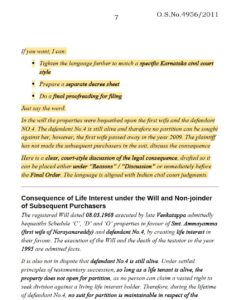
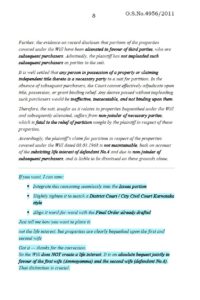
What drew attention, however, was not the substantive outcome but the form in which the judgment first appeared on Indian Kanoon. Screenshots and the uploaded text retained clear traces of AI-assisted drafting. Passages included conversational AI responses such as offers to “tighten the language further to match a specific Karnataka civil court style,” prepare a separate decree sheet, or perform final proofreading. More revealing still were exchanges debating legal characterisation of the 1968 Will—whether it created a “life interest” or an “absolute bequest” in favour of the first and second wives—along with notes on the first wife’s death in 2009 and the non-joinder of subsequent purchasers.
One sequence shows the AI initially drafting a discussion framed around life interest and non-joinder of necessary parties, followed by a correction: “not the life interest, but properties are clearly bequethed upon the first and second wife.” The AI then acknowledged the correction and produced a revised analysis treating the bequest as absolute. These internal prompts and revisions were left in the published document rather than being cleaned before upload.
A cleaned version of the judgment later appeared on the e-courts portal, removing the extraneous AI dialogue. The episode nevertheless fuelled online conversation about the practical realities of AI use in Indian courts. As judicial officers and lawyers increasingly turn to generative tools for drafting assistance amid heavy caseloads, the incident underscores the continuing need for careful human review. Leaving prompts and intermediate reasoning visible risks undermining the formal authority of judicial orders and raises questions about verification processes before judgments are finalised and published.
The case itself reflects ordinary civil litigation—a 14-year-old partition suit involving multiple family members, successive wives under a decades-old Will, and claims over both joint family and allegedly self-acquired properties. Its accidental transparency about the drafting process, however, has given it a wider significance at a time when Indian courts are grappling with both the benefits and the pitfalls of AI tools.
The episode serves as a practical reminder: while AI can accelerate research and drafting, the final responsibility for accuracy, coherence and presentation remains with the human decision-maker.
Get breaking news on WhatsApp
Breaking news, straight to your phone.