World Celebrates First UN-Recognized International Coffee Day
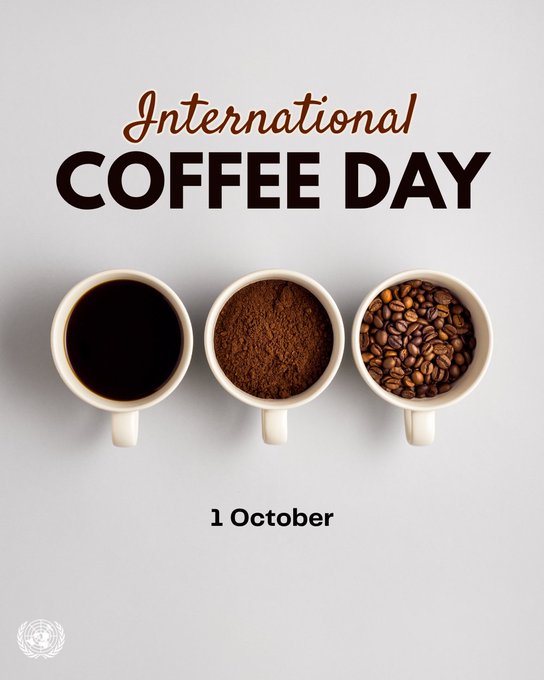
For more than a decade, coffee drinkers and growers have marked 1 October as International Coffee Day. This year the date carries a new weight: it is the first time the United Nations has officially observed it.
On 10 March 2026, the UN General Assembly adopted resolution 80/248, designating 1 October as International Coffee Day. The vote was 150 in favour, one against and one abstention. The Food and Agriculture Organization of the United Nations (FAO) is invited to facilitate the annual observance, working with the International Coffee Organization (ICO) and other partners.
The inaugural theme, used at celebrations in Rome and Geneva, is direct: “Celebrating Coffee, Honouring the People Behind Every Cup.”
From an industry day to a UN observance
Members of the ICO agreed in 2014 to share a single International Coffee Day on 1 October, the start of the coffee year and, in many producing regions, the opening of the harvest. The first common observance followed in 2015.
In July 2025, the FAO Conference adopted its own resolution calling for a UN day. The General Assembly followed in March 2026. The text recognizes coffee’s cultural, social and historical significance — not only as a traded commodity and a source of livelihood, but as a symbol of social life and everyday tradition across generations.
The resolution does not create a new fund or rewrite trade rules. It asks governments, UN bodies, civil society, Indigenous Peoples, local communities, businesses and academia to mark the day by raising awareness and sharing practices that make the sector fairer, more resilient and more sustainable.
What is in the cup
Coffee is the world’s most widely traded tropical product and one of its most widely consumed drinks. Up to 25 million farming households, mostly in developing countries, produce about 80 percent of the world’s coffee. Brazil, Viet Nam and Colombia lead production. The European Union and the United States are the largest importing and consuming markets.
For many low-income countries, coffee exports are a vital source of foreign exchange. In July 2026, global exports of all forms of coffee rose 3.3 percent year on year, to 12.23 million bags from 11.84 million bags in July 2025.
Demand is still growing. Prosperity is not shared evenly. Much of the world’s coffee leaves producing countries early in the value chain, so a large share of roasting, branding and retail value is created elsewhere. Price swings, rising costs and limited bargaining power leave many smallholders carrying the greatest risk for a limited share of the final price.
Livelihoods, climate and the goals behind the day
Resolution 80/248 links coffee to four Sustainable Development Goals in particular:
- No poverty. Coffee can support rural income and enterprise — if producers can cover costs and earn a lasting return.
- Zero hunger. Stable farm income helps households buy food, invest in their land and absorb shocks. Coffee is not itself a nutrition programme; its contribution runs through livelihoods.
- Gender equality. Women work throughout the chain. Equal access to land, finance, knowledge and income is still uneven.
- Decent work and economic growth. Growth in the sector only counts as progress if workplaces are safe and workers’ rights are respected.
Coffee is also highly sensitive to weather. Extreme heat, erratic rain, drought, pests and disease can cut yields and quality, especially for Arabica grown in cooler highland tropics. FAO and the ICO point to agroforestry, soil and water conservation, better planting material and timely climate information as practical ways to adapt — tailored to local landscapes, not imposed as a single model.
The UN also points to living heritage. Colombia’s Coffee Cultural Landscape, already on the UNESCO World Heritage List, is cited as an example of how coffee shapes land, work and culture at once.
How the first official day was marked
FAO hosted the inaugural celebration at its headquarters in Rome on 1 October 2026, opened by Director-General Qu Dongyu. In Geneva, the FAO Liaison Office joined the permanent missions of Indonesia, Rwanda and Türkiye for a high-level dialogue at the Palais des Nations, followed by a tasting that highlighted different coffee traditions.
Qu Dongyu has described coffee as more than a beverage: a commodity, from bean to cup, that sustains millions of farming households and links rural communities to markets worldwide. The point of the new observance, FAO says, is to keep that contribution visible — and to press for a sector that is efficient, inclusive and able to withstand climate and market shocks.
What the day asks of the rest of us
The General Assembly’s invitation is broad. Producing and consuming countries alike are asked to take part. Cafés, roasters, cooperatives and readers can mark the day without waiting for a ceremony: by naming where a coffee comes from, by paying attention to who grew it, and by treating sustainability claims as something that should rest on evidence rather than slogans.
International Coffee Day will now return every 1 October. The first UN observance does not settle the hard questions in the supply chain. It puts them, officially, on the calendar.
Get breaking news on WhatsApp
Breaking news, straight to your phone.