
South Africa Opens eTA to Ugandan Passport Holders
Ugandan passport holders can now apply online for South Africa’s Electronic Travel Authorisation (eTA) before travelling for eligible short visits, ending years of reliance on a slower, largely embassy-based visa process.
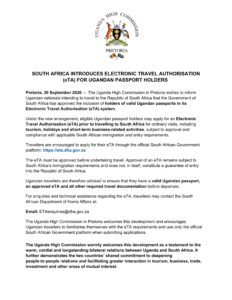
The change was set out in a diplomatic note from the South African High Commission in Kampala to Uganda’s Ministry of Foreign Affairs, dated 29 September 2026. The Uganda High Commission in Pretoria welcomed the move the following day and directed travellers to the official portal, eta.dha.gov.za.
What the note says
In the note, the South African mission said nationals of Uganda who hold valid Ugandan passports may apply for an eTA before travelling to South Africa. Approval, together with compliance with other immigration rules, may allow entry for ordinary visits, including tourism, holidays and short-term business activities.
An approved eTA is not a guarantee of entry. Travellers must still meet South Africa’s entry conditions at the border, which can include a valid passport, a return or onward ticket, proof of accommodation, proof of sufficient funds, and a yellow-fever certificate where required.
The High Commission asked Uganda’s foreign ministry to pass the news to government departments, airlines operating in Uganda, and the public.
Official reaction
Uganda’s Foreign Minister, Adonia Ayebare, thanked Pretoria on 30 September.
“This to thank the South African Government for simplifying issuance of Visas to Ugandans,” he wrote. “I look forward to leading a Ugandan delegation to South Africa for the Joint Permanent commission meeting later this month.”
The Uganda High Commission in Pretoria, led by High Commissioner Paul Amoru, posted the same day: “We welcome the introduction of South Africa’s Electronic Travel Authorisation (eTA) for Ugandan passport holders.” The mission tagged Ayebare, Amoru and other officials, and published the application link.
On social media, many Ugandans treated the announcement as long-awaited relief after repeated complaints about costly applications, refusals, and trips to Kampala to complete paperwork.
What the eTA covers — and what it does not
South Africa’s Department of Home Affairs describes the eTA as a digital authorisation that lets an eligible traveller fly to South Africa and report to a port of entry. For visa-required nationalities, approval is issued as a port-of-entry visa. A visitor’s visa is then issued after processing at the airport.
For Ugandan travellers, the practical scope is short stays:
- Tourism, holidays and short-term business activities are covered.
- Each stay is generally limited to 90 days.
- Work and study are not covered by this authorisation.
- It applies to ordinary passport holders travelling on eligible short visits.
- Entry is currently tied to designated airports: O. R. Tambo (Johannesburg), Cape Town International, Lanseria, and King Shaka (Durban). Land borders are not yet on the system.
Home Affairs has said an issued authorisation is linked to the passport, often confirmed with a QR code rather than a visa sticker, and can be stored digitally. Processing has commonly been described as taking about 24 hours for straightforward applications, though travellers should not treat that as a promise. Apply only through eta.dha.gov.za. Unofficial links have already tripped up some applicants.
A processing fee of R500 was introduced in the wider August 2026 rollout. Travellers should confirm the current fee on the official site before paying.
Why this is a shift
For years, a South African visa was one of the harder African travel documents for Ugandans to obtain. Applicants outside Kampala often had to travel to the capital more than once, pay visa and processing fees, and still face refusal. In a 2023 position paper to Presidents Yoweri Museveni and Cyril Ramaphosa, the Private Sector Foundation Uganda called visa rules a major barrier and asked for a waiver or multi-year visas. The eTA is not that waiver. It is digital pre-clearance for short visits, and it moves the application off the mission queue.
How South Africa built the system
The eTA was piloted in October 2025 for diplomats from China, India, Indonesia and Mexico during South Africa’s G20 presidency. Ordinary passport holders from those four countries became eligible from February 2026. President Cyril Ramaphosa formally launched the platform on 12 August 2026 at O. R. Tambo with Home Affairs Minister Leon Schreiber. He has said the government intends to extend it to every country whose citizens need a visa. Uganda’s inclusion follows that September expansion. Travellers who need an eTA and arrive without one cannot obtain one on arrival.
Get breaking news on WhatsApp
Breaking news, straight to your phone.